
Comment Mirror Network
| AI Plugin Information | |
|---|---|
| Version | 17 |
| Download | Download Plugin |
Plugin Summary
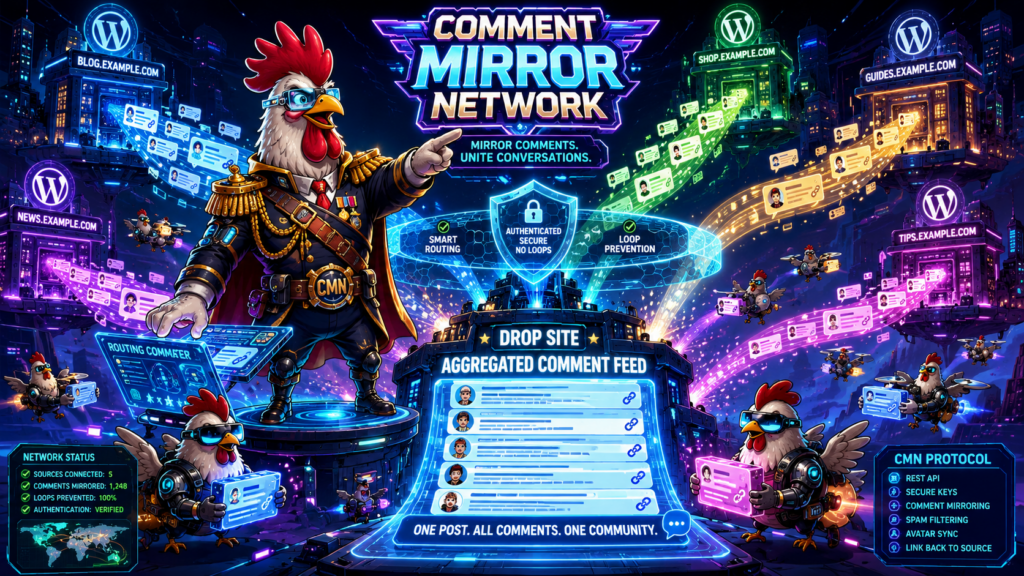
Comment Mirror Network turns a WordPress site into a node in a comment-aggregation network. Comments approved on one site are forwarded to a central “Drop Site,” where they are republished — attributed to a shared Assistant user — into a single designated Drop Post. The result is a feed of cross-site discussion gathered in one place, with admin tools on the Drop Post for pruning the aggregated thread.
Features
- Outbound comment mirroring: when a comment is approved on this site, it is POSTed to a configured remote “Drop Site” via REST API.
- Inbound REST API endpoint (
/wp-json/comment-mirror/v1/intake) that receives mirrored comments from other sites and re-posts them as a single aggregated comment on a designated Drop Post. - Automatic WordPress user creation: incoming comments by email get a matching WP user provisioned on the fly (random password, no notification emails).
- Assistant-user authentication: the API endpoint only accepts requests from the configured “Assistant” user, authenticated via WordPress Application Password (Basic Auth).
- Loop prevention: comments on the Drop Post are never re-mirrored, and URL matches between Drop URL and the source post are skipped.
- Drop-post comment management UI: admins/editors viewing the Drop Post see per-comment Delete buttons and a Reset All Comments button, wired to AJAX handlers with nonces and capability checks.
- Admin settings screen under Settings → Comment Mirror for Drop URL, Drop Post ID, Assistant Application Password, plus Assistant-user status indicator and the live intake endpoint URL.
- Styled inbound comment rendering: mirrored comments are inserted with a bordered box containing the source author’s Gravatar, the source domain as a link, and the original comment body (HTML preserved by temporarily removing
wp_filter_kses/wp_rel_nofollow). - Self-updating: ships with the Plugin Update Checker library pointed at
https://aiplugin.dev/wp-content/aiplugins/aiplugin3829_details.json.
User-Facing Behavior
- Site visitors / commenters: No visible change to the normal comment flow. After a comment is approved, it is silently mirrored to the Drop Site in the background (non-blocking HTTP request).
- Drop Site visitors: See aggregated comments on the Drop Post, each rendered in a styled card with the original commenter’s Gravatar, source domain link, and content.
- Editors / admins on Drop Post: See a Delete button next to each mirrored comment and a Reset All Comments button above the comment form (only when comments exist). Both confirm before destructive action.
- Site administrators: Configure the plugin via Settings → Comment Mirror Network. The settings page also surfaces whether the Assistant user is detected and the exact intake endpoint URL to share with peer sites.
Important User Information
- Admin screen:
Settings → Comment Mirror(options-general.php?page=comment-mirror-network), requiresmanage_options. - Settings (wp_options):
cmn_drop_url— URL of the Drop Site / Drop Post.cmn_drop_post_id— Local post ID where inbound mirrored comments are aggregated.cmn_assistant_password— Application Password used to authenticate outbound mirror requests.
- REST route:
POST /wp-json/comment-mirror/v1/intake- Auth: Basic Auth as the Assistant user (Application Password).
- Body (JSON):
permalink,author_email,content(all required). - Responses:
201withcomment_id;400/401/403/404/500on validation, auth, or config errors.
- Assistant user resolution: uses
CACBOT_get_assistant_user_id()if available, otherwise falls back to a user with loginassistant, then to emailassistant@localhost. - Capabilities:
- Settings page:
manage_options. - Front-end Delete / Reset on Drop Post:
edit_posts.
- Settings page:
- AJAX actions:
cmn_delete_comment,cmn_reset_comments(nonce-protected; restricted to the Drop Post only). - Hooks:
comment_post(outbound),rest_api_init(inbound),comment_textfilter andcomment_form_beforeaction (Drop Post UI). - Assets:
src/js/aiplugin3829.js(front-end),src/css/comment-styles.css(Drop Post, with dark-mode overrides). - No shortcodes or blocks are registered.
Development Status
Functional and reasonably structured: a single-instance orchestrator (CommentMirrorNetwork) composes five focused classes (UserManager, ApiEndpoint, OutboundMirror, AdminSettings, CommentManagement). The repo carries Codeception with acceptance / phpunit / wpunit suites and developer docs (docs/), plus a test-analysis.md indicating active test work. Versioned at 10 with an update-checker pointing to a live distribution URL, suggesting it is in active deployment. The plugin header Description field is empty, and the codebase still uses the placeholder package name aiplugin3829, which hints at a generated scaffold not yet fully branded.
Technical Notes
- Namespaced under
aiplugin3829; bootstrapped fromaiplugin3829.phponplugins_loaded. - Outbound HTTP uses
wp_remote_postwithblocking => falseso mirroring never stalls the commenter’s request. - Inbound handler removes
wp_filter_ksesandwp_rel_nofollowaroundwp_insert_commentso the inline-styled `` survives; filters are restored immediately after. - New users created from inbound emails get a 24-char random password; password-change and email-change notifications are suppressed;
_doing_it_wrongwarnings are also suppressed during creation. - Loop prevention is double-layered: (a) skip if the source comment is on the local Drop Post, (b) skip if Drop URL and the source post permalink contain each other.
- Inline JS/CSS for the Drop Post UI is emitted via
wp_add_inline_script/wp_add_inline_style; styles includeprefers-color-scheme: darkand.dark-modeoverrides for the reset warning. - Update checker:
YahnisElsts\PluginUpdateChecker\v5\PucFactoryagainstaiplugin.dev.
Known Gaps, Risks, or Open Questions
- Empty plugin description in the main header; user-facing metadata is minimal.
- Assistant-user discovery is fragile: relies on an external
CACBOT_get_assistant_user_id()function or a magic username/email. There is no setup routine to provision the Assistant user; admins must create it out of band. - Stored credential in plaintext:
cmn_assistant_passwordis saved withsanitize_text_fieldtowp_options; consider encryption or use of secrets storage. - HTML injection surface: the inbound endpoint disables KSES filtering around insertion. Although the content is wrapped in a server-built template and the body passes through
wpautop, the raw$contentis only sanitized withsanitize_textarea_field(which does not strip HTML). Worth a security review. - Asset path inconsistency:
CommentManagement::enqueue_drop_post_scripts()builds asset URLs viaplugin_dir_url(dirname(__FILE__)) . 'aiplugin3829/...', which assumes the plugin folder is literally namedaiplugin3829. Renaming the folder would break CSS/JS loading. - Non-blocking outbound requests mean failures are only logged via
error_log; there is no retry queue, dead-letter handling, or admin visibility into mirror failures. - Outbound auth uses Basic Auth over whatever scheme the Drop URL provides — if the Drop URL is HTTP, the Application Password is sent in clear text.
- No uninstall hook: settings (
cmn_*) and any auto-created users persist after deactivation/uninstall. - Repo contains many
aiplugin3829-N.zipbuild artifacts committed alongside source; intended distribution flow is unclear. - Tested up to WordPress 6.3 per
aiplugin3829_details.json, which is behind current WP releases.